


Television Ethics on The Rehearsal Season 2

I’m going to have an unpopular opinion here. Nathan Fielder shouldn’t have become a pilot. It's not an ability issue- to the point he’s trying to make, I do believe he’s capable- but it took the show further away from what I wanted it to be. I watched season 2 of The Rehearsal in one sitting after four separate people on four separate occasions told me it was the most incredible piece of work they’ve ever consumed. I’m just not sure.
I’ll give it a lot of props- it is certainly one of a kind. I couldn’t tear myself away. As a piece of entertainment, I do think it’s pretty stunning- and Fielder was clear that at the end of the day, that’s what it is. But he was also clear that he had a “somewhat sincere” intention, and did want to be taken seriously on the subject of aviation safety. I believe that storytelling should always strive to have a positive impact on the world, however big or small that impact may be. When Nathan Fielder explicitly stated the impact he wanted to have, and involved real people in achieving that goal, I believe he took on an added level of responsibility… and I don’t know that he utilized his power to the best of his ability.
First, I’ll do my best to summarize the show: comedian Nathan Fielder, through extremely thorough research, has been led to the belief that the leading cause of airline crashes is communication difficulty among pilots in the cockpit. With a desire to address this issue, and a “blank check” from HBO to make a comedy series, Fielder attempts to accomplish both goals in season 2 of The Rehearsal by creating a series of entertaining, extremely high production value social experiments that he believes may aid pilots in their communication with one another.

He makes some impressive strides. Purely by following his own train of thought and observations from hyper-realistic recreations, Fielder deduces that copilots interact with each other for the very first time upon entering the cockpit, and a lack of comfortability with one another makes first officers fearful of appearing critical of their captains. In attempting to work through this with a couple specific pilots, he discovers some personal weaknesses that unearth a pervasive issue in the profession: pilots often neglect addressing their mental health as any official documentation of their struggles can risk their license.
I found all of this interesting, entertaining, highly unusual, and productive- all the boxes Fielder stated he aimed to check. Where I start to have issue is when it came time for Fielder to act on his deductions. It began with his “in” to potential policy change: Congressman Steve Cohen. After fears that his online reputation would deter him from securing official meetings, Fielder did some research and discovered a niche fanbase he wasn’t aware he had: the autistic community.
Fielder reaches out to the Center for Autism, where he learns that the concept of The Rehearsal has been validating to many autistic people who mask in social situations and prepare for unfamiliar experiences by rehearsing them. He invites autistic children to his picture-perfect replica of the Houston airport, allowing them work through travel anxiety by becoming familiar with their environment. The relationship he builds allows him to accomplish his goal: gaining an official connection to the organization that he can use as a talking point with Congressman Cohen, an advocate for the subject. The whole thing also hints at the idea that Fielder himself may have autism, though Fielder makes a point to use ‘us’ and ‘them’ language to separate himself from the autistic community.
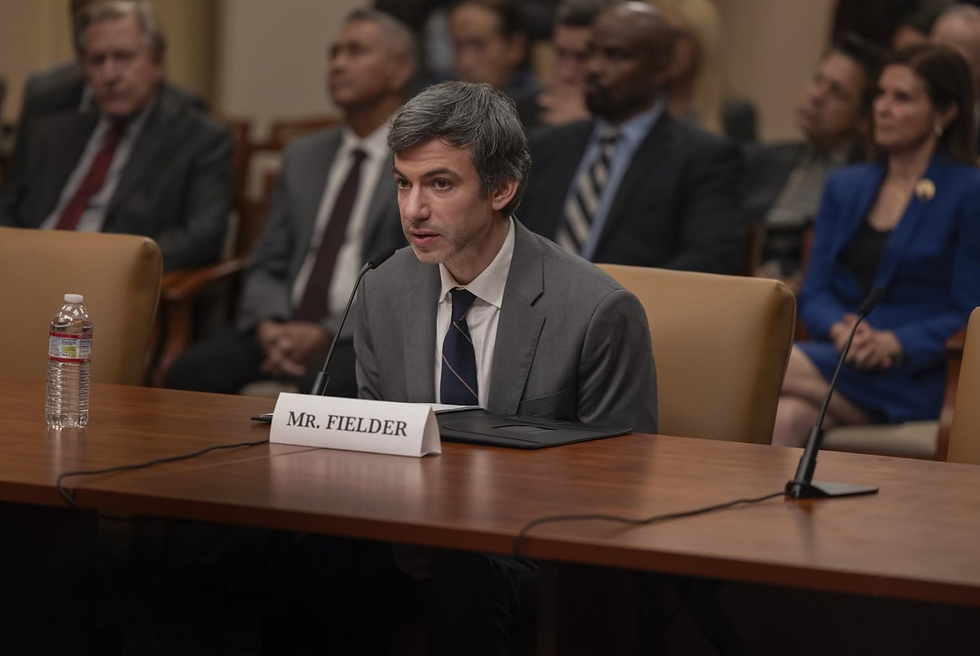
Fielder scores a meeting with Congressman Cohen- a real, taped meeting with the real Congressman. I have a couple issues with this meeting. My first thought after he reveals that it’s happening is that I don’t think we’re ready for this yet. Fielder’s ally and link to credibility in all this, former National Transportation Safety Board member John Goglia, warns Fielder that he can’t go into an official meeting without a plan. They need to have a clear policy change that they are lobbying for. At the time that Fielder enters his meeting with Congressman Cohen, we haven’t yet seen such a plan.

As he enters the meeting, Fielder also makes it a point that he did not rehearse the meeting beforehand. He states clearly that while he finds rehearsals helpful, he is not someone for whom they are a necessity- another explicit distinction between himself and autistic people. He stumbles over himself in the meeting and has to take out his notes, but for me, this is not enough of a comedic payoff to make his pointed othering of the autistic community anything other than odd and uncomfortable.
In the season finale, “My Controls”, it becomes clear why Fielder was making these not-so-subtle distinctions. Over the last two years, he himself has become a licensed pilot; for his final set piece, Fielder will finally get cameras in the cockpit of a Boeing 737 passenger plane by being the one to fly it. As he completes his paperwork that will clear him to fly a passenger plane, he experiences firsthand what the pilots he’s worked with have suggested: a formal diagnosis of autism, ADHD, anxiety, depression, and a host of other things would all pose a significant threat to their clearance to fly.
Fielder does his due diligence of seeing a psychologist and gets an fMRI which could indicate potential mental disorders (the validity of an fMRI alone in diagnosing autism or anything else is a separate conversation), but the results won’t come in until after his meticulously scheduled flight. So, he fills out the form with the knowledge he has at the time and moves forward with the flight. He will personally record the dynamic in his cockpit and attempt to utilize the communication tools he’s come up with.

The solution to in-flight tension that Fielder pitched to Congressman Cohen feels extremely anticlimactic to me. He’s essentially suggested an improv exercise be presented to a captain and first officer at the beginning of their flight. The captain plays the role of Captain Allears, a good listener, while the first officer plays the role of First Officer Blunt, a co-pilot who isn’t afraid to assert themself. Fielder describes this solution as “elegant”, “simple”, and “unobtrusive”. I would call it rudimentary. And for all the elaborate testing Fielder has done to get us to this point, I don’t think he has anything firm to justify this particular solution.
Before the flight, Goglia offers another warning: Fielder as captain inherently changes the social dynamic of the cockpit. Fielder heeds this note and makes a point to select a first officer who has aspirations in entertainment, hoping to simulate the captain/first officer power dynamic in a different way. This is extremely flimsy to me. The experience level, energy level, and intentions in this cockpit are so irregular that I don’t think anything that happens in there will be applicable in any other context.
I’m not under any misconceptions that anything done in The Rehearsal is meant to hold up in court or under the scientific method. But by this point the show has fundamentally shifted in the fulfillment of both of Fielder’s goals: comedy and aviation safety awareness. For me, a large source of comedy was in the massive scale recreations of airports, cockpits, and apartments; not a single thing would differentiate the set from the real thing- except Fielder standing awkwardly in the corner wearing a laptop harness. His presence in the character he’s created for himself- uncomfortable omniscient observer who has somewhat inadvertently stumbled into having ungodly amounts of money to burn- is endearing and funny.

We lose that when Fielder centers himself in the narrative. He’s no longer just an awkward guy spending all of HBO’s money to help some pilots gain some self-confidence. Now he’s a guy spending all of HBO’s money to find a loophole that will allow him to be the least experienced person ever to fly a fully passengered Boeing 737. He’s playing God. And with any real productive outcome more unclear than ever, it’s just unnecessary and uncomfortable.
Narratively, I get it. The entertainment value is huge. The full circle experience of him becoming the pilot plagued by the obstacles he set out to overcome isn’t lost on me. And I don’t think he’s a bad or dangerous pilot. But he asked me to take him seriously. He said he wanted to enact real change. I think he could’ve made more of an impact on the issue if he’d kept being the guy in the corner with a laptop harness.
The thing that really got me was how Fielder justified the flight to Goglia: “I’m willing to take that risk, you know? I have my qualifications, but if I talk about my feelings and, you know, I’m being too transparent and I lose my license, okay. Because I don’t need to do this as a career. If it means I can prove the point we’re trying to make, maybe that’ll be worth it, no?”
He actually pulled me back in when he said this. If he went through the painstaking experience of becoming a pilot just to prove how little it took to lose those credentials, that would feel incredibly in the spirit of what he does. Of going to great lengths to replicate a life scenario purely to make a point. But he doesn’t do that. He discovers that he likes being a pilot. So, he doesn’t keep this promise, and that was a letdown to me.
The flight itself is extremely anticlimactic. Both Fielder and his first officer are palpably awkward and nervous- but there’s no real data to be gleaned from this dynamic. Is it awkward because Fielder is awkward as a person? Is it awkward because there are cameras? Is it awkward because Fielder is in fact excessively checking in with his first officer? At some point in the flight Fielder implements his improv method, giving his first officer the character of First Officer Blunt. I’m not sure why this wasn’t done before the flight, but from what I could see, it had no real impact. And when the flight was over, Fielder offered no significant reflection on what the takeaways were in terms of copilot communication.
Instead, he was caught up in the euphoric feeling of safely landing a plane filled with people. He reveals that he has continued flying Boeing 737s since that flight, transporting empty planes that need to be moved from remote locations. He clearly has come to feel protective over his status as a pilot. When his psychologist calls him back with results from his fMRI, he deletes the message.
Ultimately, I think Fielder succumbed to his fear of not being taken seriously. He sacrificed going the extra mile and crossing the legislative finish line for his comfort zone of making a good TV show. And it did make a good TV show. Blurring the lines of narrator and subject, fiction and reality, is compelling. Becoming a part of the problem he had set out to solve is great storytelling. It’s cinematic. But it’s not helpful.
If Fielder had embraced his autistic tendencies, had seen his potential diagnoses to the finish line, it would’ve been much more powerful. Either he wouldn’t have lost his license, proving that it could be done, or he would’ve, highlighting a systematic flaw in the vetting process. Alternatively, if Fielder had stayed in the background, creating more social experiments for experienced pilots, he could’ve derived a more actionable conclusion that could actually hold weight with lawmakers. These alternatives would change the show, but they wouldn’t cost entertainment value. They would just cost Nathan Fielder the bragging rights of being the pilot front and center of the show that claimed to be supporting the people who actually do this for a living.


Comments